Why Senior Living Options May Get Tighter in Washington
Apr 29, 2026
Mary
Watkins
Most families do not start looking for senior living because they want to. They start because something changed.
A parent fell. Dementia symptoms became harder to manage. A spouse became exhausted. A hospital or rehab discharge created a deadline. Or the family finally realized that the current situation was no longer safe.
At that point, the question is usually not, “What senior living options exist in Washington State?”
It is much more specific:
“What options are realistic near us, for this person, right now?”
That search may get harder over time, and not just because of one market report.
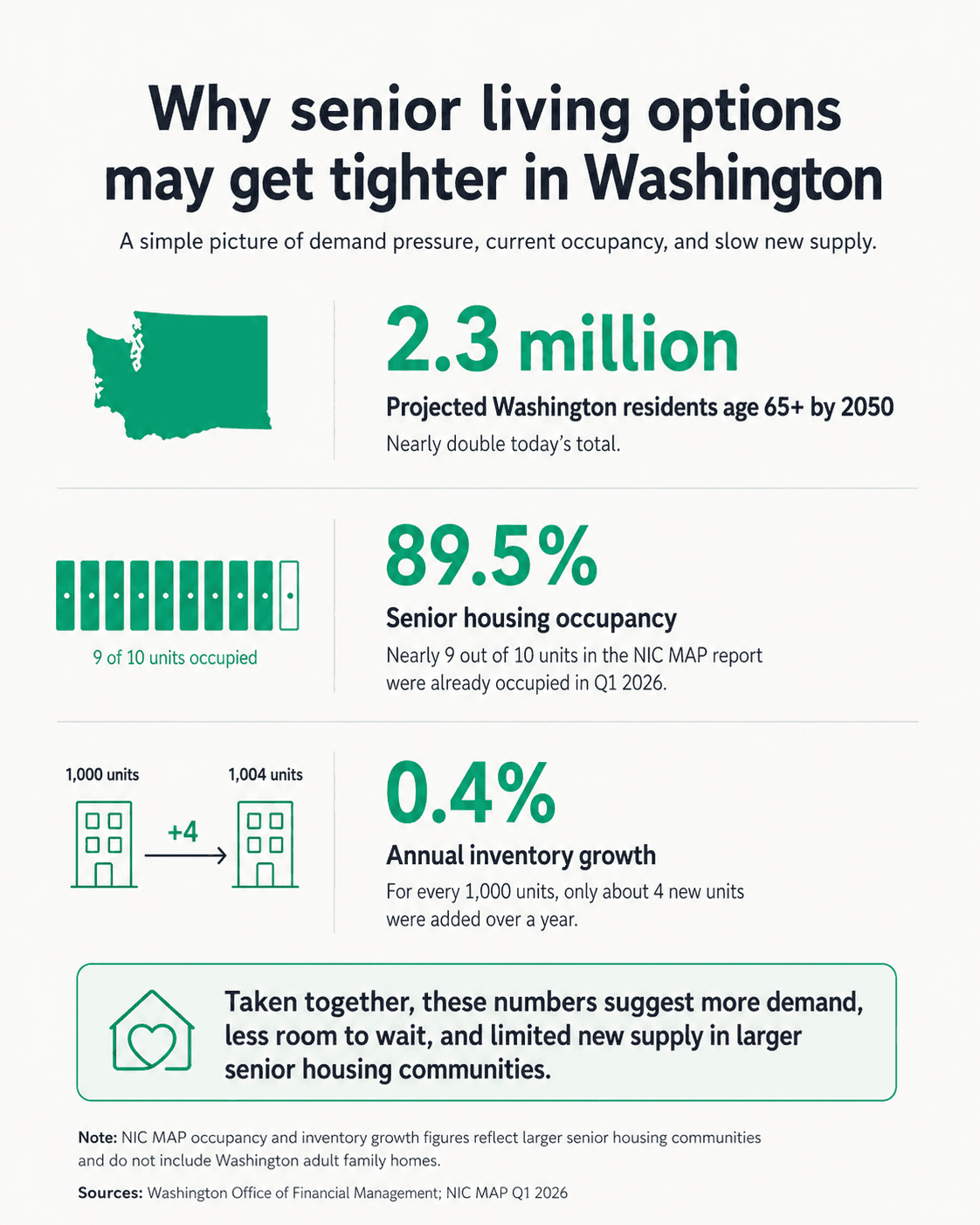
In Washington, the bigger picture matters. The state’s older adult population is projected to grow substantially in the years ahead. The Washington Office of Financial Management projects about 2.3 million Washington residents age 65 and older by 2050, nearly double today’s total. That means more families will be looking for care, support, and housing options over time.
At the same time, a recent NIC MAP report shows that larger senior housing communities are already operating with limited slack. In the first quarter of 2026, senior housing occupancy reached 89.5% across primary markets. Assisted living occupancy was 87.9%, independent living was 91.1%, and annual inventory growth was only 0.4% overall. In simple terms, occupancy was high, and new supply was barely growing.
That does not mean there are no options. It does mean families may have less room to wait, especially when they need a specific location, care level, budget, or timeline.
It is also important to understand one caveat. NIC MAP reflects larger senior housing communities, not Washington’s adult family homes. That matters here, because adult family homes are a major part of the local care landscape.
So the real story is not, “Everything is full.”
The real story is this:
Demand is growing. Larger senior housing is already relatively full. New supply is growing slowly. And in Washington, families often need to sort through very different care settings to find the right fit.
Why this matters in Washington
Washington families are usually not searching across the whole state.
Most are looking within one city, or within a small cluster of nearby communities. A family may be comparing options in Bellevue, Redmond, and Kirkland. Another may be focused on Tacoma, Everett, Wenatchee, or one part of Seattle.
That local focus matters.
A community 40 minutes away may technically have an opening, but it may not work if a spouse still drives locally, adult children need to visit after work, the person has longstanding doctors nearby, or the family wants to keep them close to a familiar neighborhood or support system.
This is why “there are openings somewhere” is not always helpful.
Families usually need an option that works in real life. It has to be close enough, appropriate for the person’s needs, financially realistic, and available at the time the family needs it.
That combination can be harder to find than people expect.
Why new senior living communities are not easy to add quickly
Washington has real constraints that affect how quickly larger senior housing can expand.
In many high-demand areas, land is limited and expensive. Construction costs are high. Local zoning, building codes, permitting, and project review can all affect how long it takes to move from an idea to an open building.
Even when demand is clearly there, a new assisted living or independent living community can take years to plan, finance, permit, build, staff, license, and open.
That is one reason the NIC MAP inventory growth number matters. 0.4% annual inventory growth is a very slow pace. It means new, larger community supply is not expanding quickly.
So when you combine demographic growth with already high occupancy and slow new supply, it becomes easier to see why families may feel more pressure over time.
Adult family homes change the picture, but they do not solve every situation
This is where Washington is different.
Washington has a large adult family home market, and that gives families more possible pathways than they might see in a national senior housing report. Adult family homes open more often than large communities, and they can be an excellent fit for many people.
But they are not the right fit for everyone.
Some older adults do best in a smaller, quieter setting with more hands-on help. Others want more activity, more social variety, more amenities, or a private apartment-style environment. Some need memory care support. Some may need to think about Medicaid later. Some need a location that makes regular family visits realistic.
So while adult family homes are an important part of the Washington care landscape, they do not erase the larger issue. Families still need to find the right setting, not just any opening.
That is why availability alone is not enough.
What these numbers really mean for families
Families do not need to memorize occupancy percentages or inventory growth charts.
What matters is the practical takeaway.
When more older adults will need care, when larger senior housing is already running close to full, and when new supply is only growing slowly, families may have:
Less room to wait
Less flexibility if a crisis happens suddenly
Fewer good choices in a preferred area
More pressure to make a decision quickly
A harder time finding the right fit if needs are more complex
This does not mean every family should move now.
It does mean families should understand their options earlier.
That is an important distinction.
The mistake is not waiting. The mistake is waiting without a plan.
When should families start looking?
Families should start learning about options before the situation becomes urgent.
That does not mean moving right away. It means understanding what is realistic before a crisis forces the decision.
It may be time to start looking if you are seeing:
Increasing falls
Missed medications
Memory loss or unsafe decisions
Wandering or exit-seeking
Poor nutrition or weight loss
Isolation
Trouble bathing, dressing, or transferring
Caregiver burnout
A recent hospital or rehab stay
A spouse or adult child who can no longer provide safe care
These signs do not always mean senior living is the immediate next step. But they do mean it is time to understand the options.
What families can do now
A good first step is to get clear about the person’s current needs and likely next needs.
For example:
Is the main concern safety, memory loss, falls, medication management, isolation, or caregiver burnout?
Would the person do better in a larger assisted living community, or in a smaller adult family home?
Is private pay realistic long term, or could Medicaid matter later?
How far can family realistically travel for regular visits?
Are there care needs that may limit which providers are appropriate?
Those questions help narrow the search. They also help families avoid spending time on options that look good online but are not realistic once the details are understood.
Why guidance matters
Senior care can look simple from the outside.
There are communities, adult family homes, websites, reviews, and lists.
But when a family is actually trying to decide, the search usually feels more complicated.
There may be several paths, but not all of them lead somewhere workable. Some options are too expensive. Some are too far away. Some cannot manage the care needs. Some look fine today but may not work six months from now.
Families do not just need a list of places. They need help understanding which options actually fit the person, the family, and the situation in front of them.
Need help understanding your local senior care options?
Silver Age helps Washington families compare assisted living, memory care, adult family homes, and other care options based on the person’s needs, location, budget, and timing.
Starting early does not mean moving before you are ready. It means understanding what is realistic before the decision becomes urgent.
Get Your Personalized Care Roadmap
FAQ
Why might senior living options get tighter in Washington?
Washington’s older adult population is projected to grow significantly over time. At the same time, larger senior housing communities are already operating at high occupancy, and new supply is growing slowly. That can make the search harder, especially when families need a specific location or level of care.
Does the occupancy data include adult family homes?
No. The NIC MAP occupancy and inventory growth figures reflect larger senior housing communities. They do not include Washington adult family homes, which are a major part of the local care landscape.
Does that mean there are no options?
No. It means families may have less room to wait, and the best local options may narrow more quickly, especially when care needs, timing, and budget all have to line up.
Are adult family homes easier to find than assisted living?
Sometimes. Adult family homes may have more frequent openings because they are smaller and more locally distributed. But an opening does not automatically mean it is the right fit. The home still needs to match the person’s needs, personality, budget, and future support needs.
When should we start looking for senior care?
Start learning about options before there is an urgent need. That may be when falls, memory problems, medication issues, caregiver burnout, or safety concerns are becoming more frequent. Starting early does not mean moving right away. It means understanding what is realistic before the decision becomes urgent.

Mary
Watkins
Mary’s journey with senior care began with the challenges her mother faced. Knowing that she could no longer safely remain in her home, the family started searching for the best care provider, ultimately deciding on a wonderful adult home close to Mary and her family. Her mother spent the last five years of her life receiving excellent care and enjoying a quality of life she would not have had otherwise. This personal experience opened Mary’s eyes to the multiple benefits of quality senior care.


Ready to Talk?